



Work Orders Versus Completed Works:
Are Your Services Actually Being Delivered?
How much of the work you pay for is actually being completed? Did you know that while a closed work order often tells you a job has been marked as ‘complete’, it doesn’t tell you whether the full scope of work was actually delivered? For Facility Managers (FMs) overseeing multiple sites, contractors and service agreements, that gap can mean paying for work that was incomplete, outside agreed standards, or never carried out at all. Learn how you can move beyond work order closure and gain clear evidence of what is actually being delivered on your sites.
TL:DR – Key Takeaways
- Work order closure does not equal work completed: Closing the administrative workflow does not prove the contracted scope was completed.
- No evidence means limited assurance: Without on-site delivery data, FMs may be approving work they cannot confidently confirm occured.
- Pay for completed works: Connect payment and performance decisions to evidence of actual service delivery, not work order status alone.
Work Order Status – When ‘Closed’ Doesn’t Mean Complete
Work order systems give site management teams an efficient way to issue, manage and track maintenance and repair works across large portfolios. They provide visibility over whether a work order is open or closed, helping teams manage significant contracted workflows across multiple sites and contractors.
The problem, however, is what a ‘closed’ status proves. Once a work order is marked complete, it is often assumed that it is accurately closed, and the contractor’s invoice can be processed for payment. The work order status itself provides limited evidence that the contractor attended the site, completed the full scope of work, or delivered the service to the agreed standard. This creates a gap between administrative completion and actual service delivery, leaving Facility Managers with limited visibility over whether the work they are paying for was actually completed.
Paying in Full for Incomplete Jobs
Once a closed work order becomes the trigger for invoice approval, the evidence gap becomes a commercial risk. FMs may be approving payment based on the administrative status of a job rather than evidence that the contracted scope was delivered in full. This issue is often compounded by how work order performance is managed day-to-day:
- Closure-driven KPIs: FMs’ work order performance is often measured by how quickly work orders are issued and closed.
- Limited evidence capture: Existing work order systems may not capture evidence of what was completed on-site.
- Contractor-managed closure: Contractors or their administrators may be able to close their own work orders through a web portal, without independent confirmation of delivery.
- Binary work order status: Systems often provide only ‘open’ or ‘closed’ statuses, with limited ability to distinguish incomplete or partially completed works.
At scale, these gaps can be difficult to identify. A closed work order can move through to payment despite part (or potentially all) of the work order remaining incomplete. Verified’s own review of work order delivery over thousands of contracts and hundreds of sites continues to identify cases where allocated work was not completed at all, despite the Building Owner having already paid for the services in full.
Pay for What You Receive
There is immense value for companies seeking to gain full visibility into their work order process and transparency of on-site activity. Verified integrates with existing work order systems to connect the administrative workflow with evidence of service delivery, giving FMs a centralised view of work orders as they move from issue through to completion. Users can easily track, approve, report, and synchronise work order status accurately against contracted terms, standards, and agreed service levels. This allows clients to only pay for the services that have been delivered, accepted, and completed.
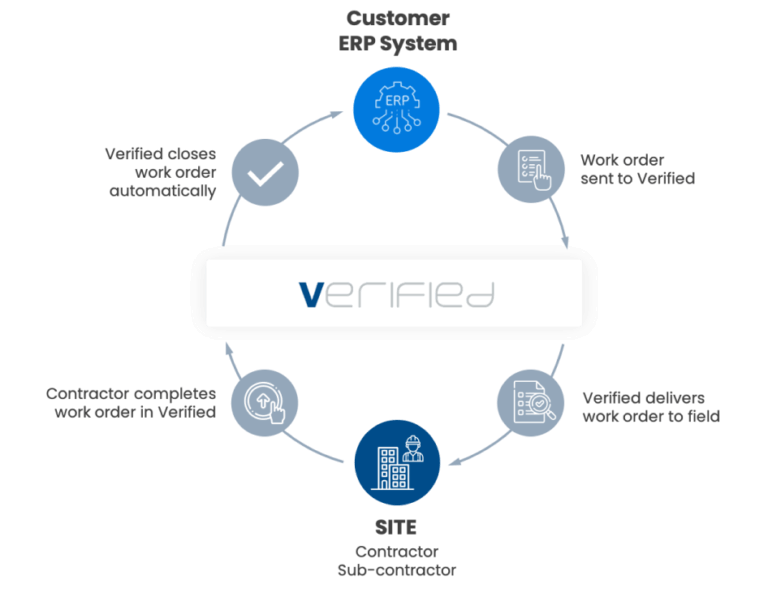
To provide clearer evidence of service delivery, Verified enables:
- Direct delivery of work orders to on-site technicians, including subcontractors.
- Real-time data capture and status updates on work orders for all parties.
- SLA monitoring and compliance aligned to contracted terms and conditions.
- Centralised and real-time reporting.
- Automated work order closure via on-site technicians when delivered to specification.
- Overall increased organisational efficiency and safety.
In practice, Verified’s work order management integration creates a direct link between the work order issued and the work delivered on-site. Completion is captured against the required scope, standards, and SLAs before the work order is closed within a client’s ERP. The result? Verified clients gain complete confidence that work orders reflect actual service delivery and what should ultimately be approved for payment.
Want Clearer Evidence of What’s Being Delivered?
A closed work order should give you more than an administrative status. Schedule a demo today and see how Verified can help ensure you pay for completed work, not simply closed work orders.